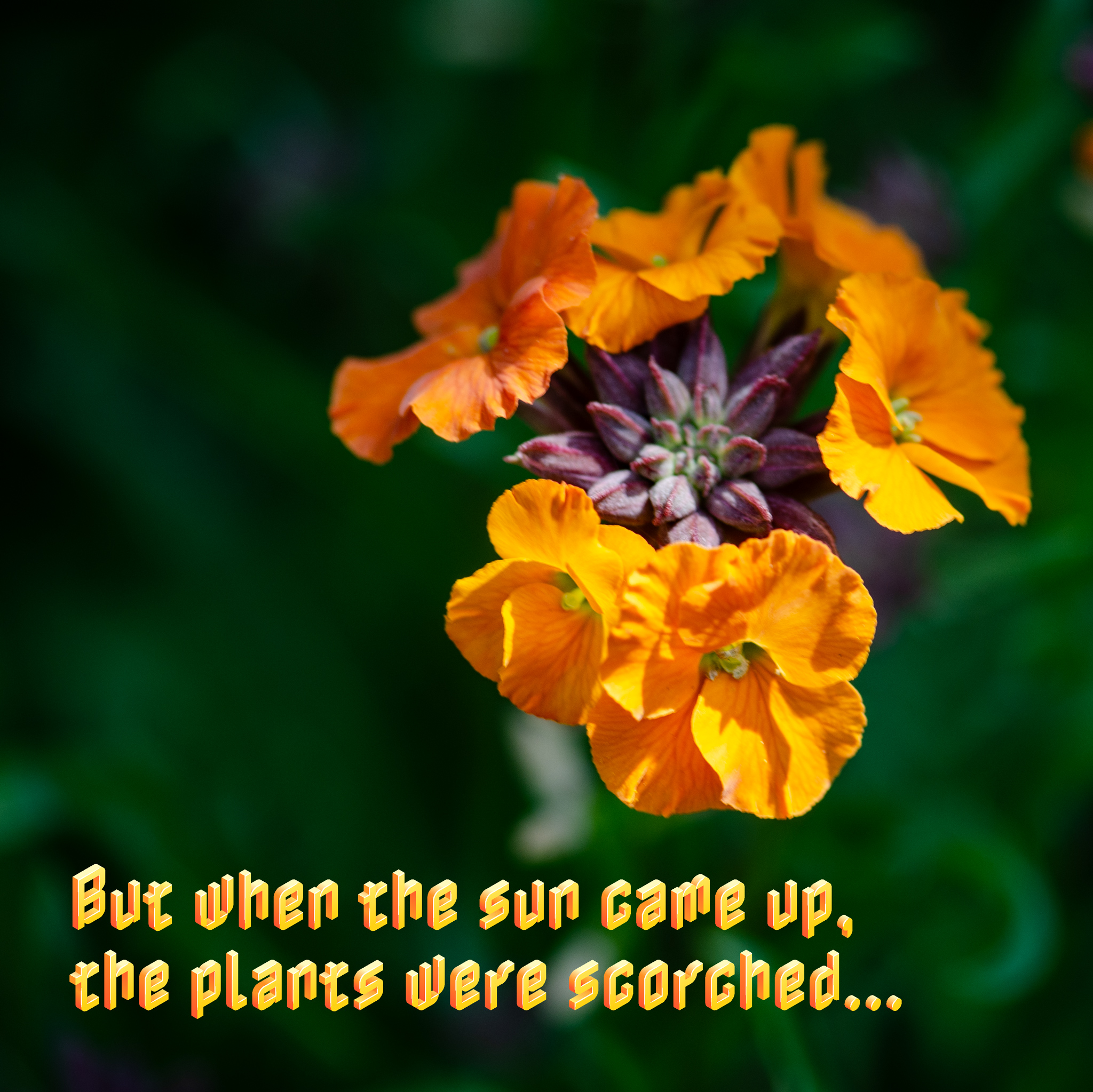
It’s been the longest & hottest summer on record in Bognor Regis. At last some rain has arrived, and thoughts are turning to garden survival. British summers are hotter and drier, winters are mild and wetter. Quite a number of annuals and shrubs have succumbed to the extreme dry heat. What’s a poor gardener to do?
Rethink the way we go about gardening, that’s what!
Old favourites are struggling to survive- our soil has clay deposits that go rock-solid in the sun, but quickly slide into soggy suet-pudding-textured-goo in winter. Even my reliable perennial wallflowers have been hit hard. It only seems a few days ago that the buds were breaking into gorgeous orange and regal mauve. Now, they are barely more than straw, withered and pale. There is nothing I can do for the dead ones. Do I buy replacements? Or look for alternatives that may suit the changed conditions better?
One of the best-loved parables of Jesus is called “The Sower”. The farmer sows seed by hand-casting it across his field; it falls on all kinds of soil, a rocky pathway, among weeds… some falls in “good” fertile ground and produces a fantastic harvest. (Matthew 13:3-9)
Jesus is describing the way the “good news” of love and reconciliation is spread. It is cast abroad: some people hear/receive it and faith blossoms. Others, for various reasons, are unresponsive. There’s nothing wrong with the gospel, but not everyone takes it on board.
If we re-think the story as an evangelistic strategy, an obvious solution is to sow more carefully, planting seed ONLY in fertile ground. Yet God’s Love is more generous than that: Christ wishes to “reconcile ALL things” (Colossians 3:20) so love is shared widely and those who hear it are living with responsibility for how they treat the gift. Weeds will choke some, birds will steal some, and some will be shrivelled by the harsh sun.
Gardens can be re-arranged. Drought-resistant plants can be grown; irrigation can be put in place. But if we carry on with the “golden oldies” of English beds & borders and don’t stay “up-to-date” with the climate quirks, we will be responsible for next years’ failure if summer 2027 is another drought.
So too our life as obedient servants of Jesus: we must think carefully about our methods, our targets, and our role to be ambassadors of the Generous God. How do we speak, what cultural language is appropriate. Our fellowships exist for the benefit of those who aren’t yet our members (so not for our “club” of cosy comfort). The societies we live among can be a harsh environment: and there are many decent people as well as rogues and monsters.
The right time, the right attitude, & the right place = blessing. It will still be hard work though!
Or we can abandon the stony, the overgrown, and the hostile to be left without hope. Should we? I cannot bring myself to believe we have the right to refuse to share the seeds of grace, so re-thinking and prayerfully seeking guidance has to be the way to go. Who knows? The garden sown by grace will have beauty and surprises galore.
Scorching out! Grace in its place. Amen?

