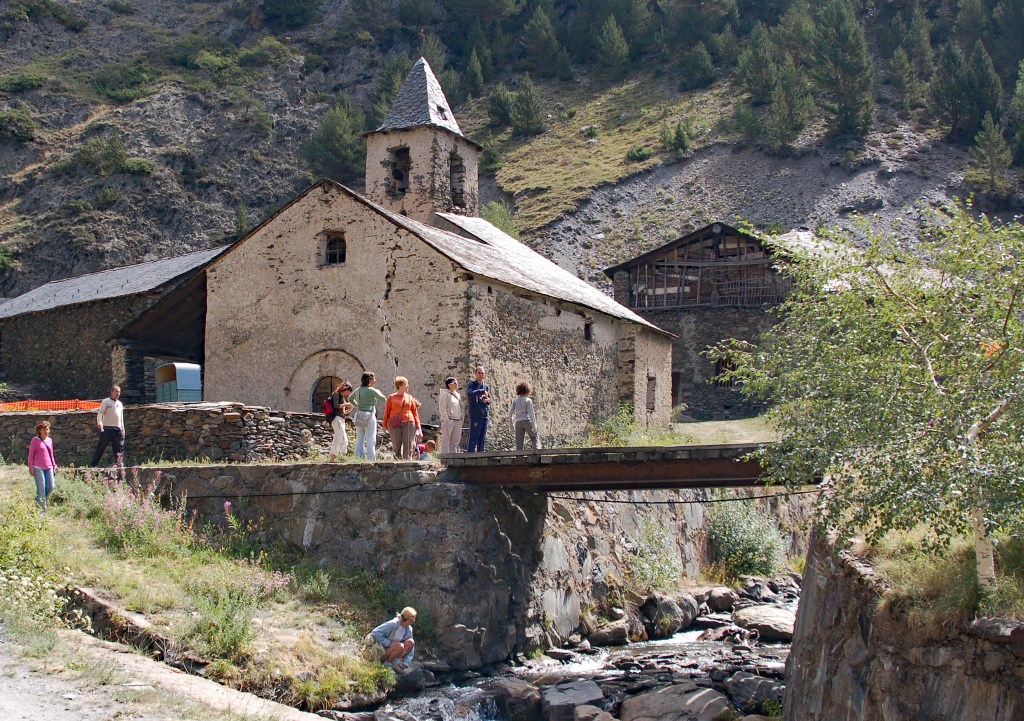
Andorra is a tiny country in the mountains that separate Spain and France. Most visitors these days come as tourists to enjoy the air and beauty of the Pyrenees. Back in the “bad old days” life was mostly about smuggling stuff across the borders. Our visit included a nostalgic trip in a Landrover, following the smuggler’s route.
Life up here was tough and often short. Today, some of the houses are “second homes” for city folk; most of the others are used in the tourist trade. It has become a quiet backwater where nothing much happens.
The “village” amounted to a small church, some dilapidated barns, and a handful of sturdy stone cottages. We wandered across the bridge, heading for strong coffee in a tiny cafe. Our guide was very informative about the history. Peasant farmers scratched a living in the arid valleys, and “played the system” to boost income. Strong spirits and coarse tobacco traded over a network of routes serving France, Spain, and Andorra. Locals used their wits and outsmarted the Tax officers by exploiting the hidden ways through the mountains.
I imagine it was dangerous and probably violent when smuggling was rife. The footsteps of history are often bloodstained. I found it quite evocative: I could visualise it as a setting for the parable of the “Good Samaritan” (Luke 10:25-37). A desert road, hot and dusty, where bandits lurked malevolently; an innocent merchant beset by robbers who left him for dead.
Why did Jesus talk about the dangers of the mountain trails?
Jesus is answering a sneaky question about eternal life- in a most unusual way. Luke tells us (v25) that the intent of the questioner is to trap Jesus into the legalist maze. First Jesus requires the man to define what he as a Teacher of the Law understands the Scriptures to say: The man answered, “‘You must love the Lord your God with all your heart, all your soul, all your strength, and all your mind.’ And, ‘Love your neighbour as yourself.’” (Good answer.) “Right!” Jesus told him. “Do this and you will live!” The man wanted to justify his actions, so he asked Jesus, “And who is my neighbour?”
If only the Teacher had quit whilst he was winning… By asking his second question, he opened the door for a potent parable that upsets all the custom and tradition of the religious establishment. Jesus weaves a pointed narrative.
The “hero” comes from the despised Samaritans; he demonstrates compassion through a practical love and basic human decency by generously aiding the victim. The priest and Levite self-justify their refusal to help by relying on a ceremonial righteousness… but when Jesus asks the Teacher to say “Which of the three acted like a neighbour to the man who was robbed?” the only possible answer is “the one who was KIND to him.”
Can it be so simple? Being kind?
To walk in Jesus’ footsteps is to be as He is, to do as He does, and to love as He loved. Wholehearted love for God- “heart, soul, strength and mind” cannot be separated from loving my neighbour as I love myself (v27).
Imagine the difference it makes when a community is known for acting in kindness because we are being shaped into the likeness of Jesus! Footsteps worth following are the ones walking the way of Love.

