Amos 7:7-17 & Luke 10:25-37
Craft – make a plumb line
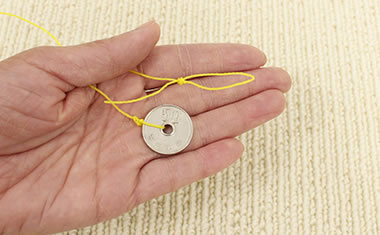 You will need:
- string
- a large washer (or a fancy coin with a hole in the middle, like this one)
- Optional – gold paint or paint pen
The washer has a hole in the middle – it’s ‘holey’ (arf arf!) It also looks like a halo, reminding us of God’s goodness and glory. You can paint the washer gold to make it look even more like a halo.
Tie the washer to the end of the string and hang it somewhere visible. When you see it, remember that we are called to live by God’s standards and not by those of this world.
Reflection
I like Amos. I imagine him as a bluff, plain-speaking Yorkshire farmer – mud on his knees, flat cap on his head and wellies covered in … ummn, I don’t think I want to know.
Amos is no highfalutin scholar, no hereditary prophet. He’s a plain old sheep farmer with a sideline in pruning trees, and God’s message to Amos is similarly down to earth. “What do you see, Amos?” “A plumb line.” “Right you are, Amos, lad.”
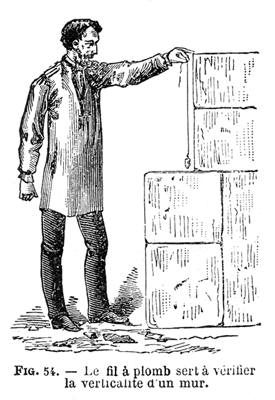 For those of you who don’t work in the building trade, a plumb line is a piece of string with a weight (a plumb bob) tied to one end. You hang it next to a wall to check that you are building it straight. This is important because if your wall is not straight, if it’s leaning outwards, say, then when you put the roof on top, the weight will push out instead of down and you could have the entire house collapse on top of you.
(Traditionally, the weight was made from lead, in Latin, plumbum, and hence plumbers, who made Roman pipes from lead, and the symbol for lead, Pb. Interesting, innit?)
God’s message through Amos was that God was hanging a plumb line next to his people and – golly gosh, what a surprise – they didn’t match up. They weren’t living God’s way and kept building rubbish brickwork on top of rubbish brickwork until they ended up with something out of Diagon Alley.
 (This pic is the Crooked House of Windsor – genuine and for real.)
Israel was a crooked wall, and the best thing you can do with a crooked wall is take it down and build it again straight. God had given his people chance after chance to put it right and they hadn’t, so God would do it for them. It wouldn’t be pretty and it wouldn’t be pleasant, but it would be good. Because God is good.
But what about me? What would happen if God held his plumb line next to me? The prospect of having my brickwork assessed by the standard of God’s perfect holiness is kinda uncomfortable. It makes me squirm in my seat. Yes, I’m saved through grace alone, on the basis of Jesus’ righteousness, but I am still called to live a life worthy of the calling I have received, (Eph 4:1) and I’m not very good at that.
Now, important stuff – if you don’t remember anything else, remember this bit. God does not love us because we (try to ) live a good life. God loves us because he’s nice like that. The thief on the cross: not a single Bible study or food bank donation, but God loved him enough to die for him.
So, no perfection this side of glory, and God understands that I’m gonna mess up, but I am still expected to try.
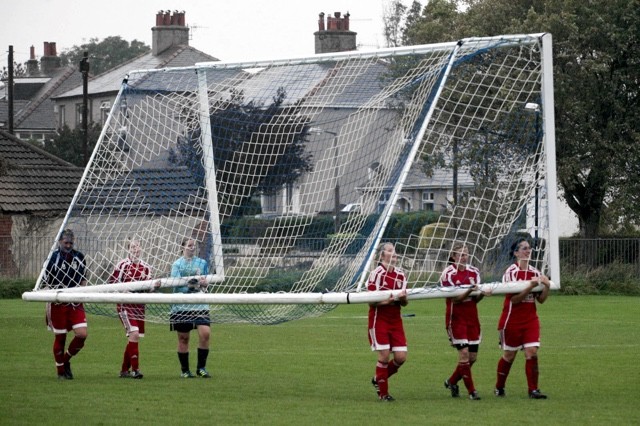 However, this does not fit well with contemporary culture. Absolute standards are not fashionable and we’re very good at installing moveable goalposts, if I may shift the metaphor. “I might have done this,” we say to ourselves, “but at least I didn’t do that – and I’m not as bad as so-and-so.” Moveable goalposts. “Weeeeell, everyone does it, so it can’t be sooooo bad, can it?” Moveable goalposts. It happened in Jesus’ time, too. He even told a parable about it:
“God, I thank you that I am not like other people – robbers, evildoers, adulterers – or even like this tax collector,” said the Pharisee. “I fast twice a week and give a tenth of all I get.”
But the tax collector beat his breast and said, “God, have mercy on me, a sinner.”
I tell you that this man, rather than the other, went home justified before God. For all those who move the goalposts to make it look like they’ve scored will be humbled, and those who realise they’ve missed and beg for help will be exalted. (Luke 18)
OK, I re-wrote the last sentence a bit. But I’m sure Jesus would have said that if the FA had been invented back then. The parable of the Merciful Samaritan is another example. The robbers certainly weren’t building straight walls, but I guess at least they knew that. The problem was with the priest and the Levite who both thought they were playing by the rules but God judged them offside. This gets repeated over and over in parables of sheep and goats, bridesmaids, tenants etc. Some folks move the goalposts so far they don’t even remember where they used to be.
 So how do we avoid MGS (moveable goalposts syndrome?) How do we make sure we’re not building wonky walls? To quote the psalmist, ‘How can a young person (or one of riper years!) stay on the path of purity?’ (Ps 119:9)
The answer comes right after. ‘By living according to your word.’
To put it another way: Check which plumb line you’re using. Are we measuring ourselves against the ways of this world, the fashions of contemporary culture, or against God’s eternal standard? We’ll often get very different answers.
What’s your plumb line and how will you check if you’re building true?

