Greetings ‘Flectioneers! Welcome to the boring part of the year: we’ve packed away the decorations and our houses are boring; we’ve (mostly) stopped wearing Christmas jumpers and our clothes are boring; we’ve watched all the specials we recorded over Christmas and the telly is boring; we’ve eaten those posh biscuits we bought and our food is boring. Even the weather is grey and boring.
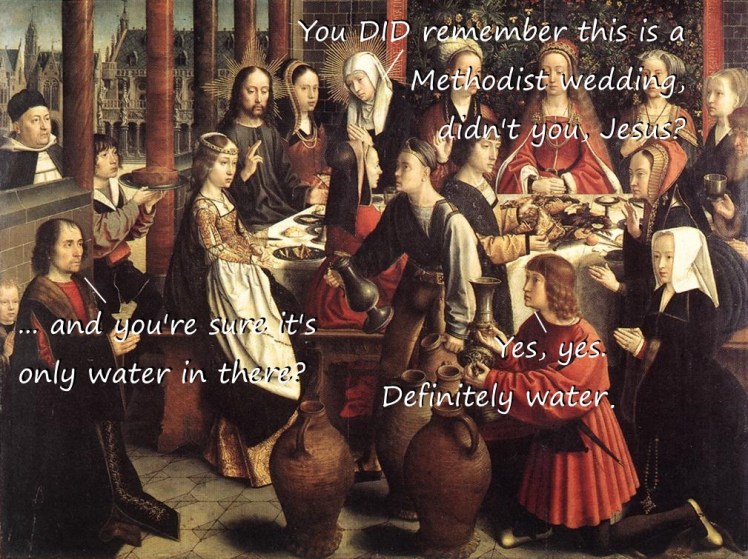
But fear not! I am sitting here in a sparkly jumper and cute socks I’ve owned for just over two weeks (they’ve been washed, I assure you) to bring you the joy and delight that is Sharon and Wayne’s Wedding – a light-hearted look at the first of the signs recorded in John’s gospel.
In addition, your liturgy resources based on Psalm 35 are at the bottom of the post, and I’ve linked in some scholarly posts from saint Ian Paul, plus a re-post of my own musings on this passage from 2016 and some not-very-scholarly-but-fun Puzzle Pages.
May the diet you’ve been putting off until you finish the Christmas cheese continue to be put off for many weeks yet.
blessings,
Fay xx
 Resources for John 2

- Sharon and Wayne’s Wedding (with just a hint of armadillo!)
Hilarious sketch with free script and bonus MP3 so you can see (hear) how we did it. Enjoy! - Stone Jars Ian Paul (Psephizo) on the wedding at Cana
- Video discussion, also from IP
-

A Reflection
“Do whatever he tells you.”
I love Mary’s words here. She has no idea what Jesus is going to do, but she knows it will be OK. And this is not some great, earth-shatteringly important world event. It’s a friend’s wedding, and the caterers have messed up.
This is ordinary, real life. And God is right there, being involved. This is prayer about real things.
Sometimes I feel a bit of a fraud when I pray. A friend is ill. Do I pray for miraculous healing, or for a favourable outcome to his latest blood test, or for fortitude to cope with the symptoms? Exams time. Do I pray for straight As, or for good questions, or for a positive attitude for whatever results I get?
I don’t want to second-guess God, or tell him what I think he should do, but I feel like a fraud for praying ‘do whatever you think best, God.’ Isn’t that a bit of a cop-out?
I suppose it is. It’s an easy prayer and I can look back and say ‘Yep, my prayer was answered’, no matter what the outcome. It feels a bit wish-washy. There is none of the assurance that comes with praying for a specific outcome and then seeing it.
So which should I do? Should I use my limited wisdom and imperfect grasp on the whole situation to pray that a friend will pass her driving test, or bring it before God and leave the rest up to him? What if God wants her to fail?
Should I be bold and specific in prayer, or is it that telling the Almighty what to do, thinking I know better than him? Should I be more general, humble in the face of God’s wisdom, or is that being feeble and faithless?
I’d say both. Daring prayer is good. But we do not have to plan God’s solutions for him. We can trust that our Lord knows what he’s doing better than we do. “As the heavens are higher than the earth, so are my ways higher than your ways and my thoughts than your thoughts.” (Isa 55:9) However, we also need to make sure we are not just evading specifics with a limp-wristed, wet-lettuce Christianity that can never see answered prayer because it is so vague that anything is an answer and not.
God loves to hear us pray and wants us to bring our requests to him, however small. “Do not be anxious about anything, but in every situation, by prayer and petition, with thanksgiving, present your requests to God.” (Phil 4:6) We also need to bring the big issues before him, not because he does not know, but because in doing that we can join our hearts and minds with his. Praying is much more about changing us than changing things.
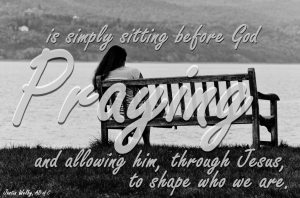 I love this quote from Archbishop Justin Welby, “Praying is simply sitting before God and allowing him, through Jesus, to shape who we are.” Or this, from Michael Ramsey, who said that prayer is “coming to God with the people on your heart and coming to the people with God on your heart.” Prayer does not have to use words.
So sometime I will pray for a specific outcome. But if it does not happen, that does not mean that God is not listening, or does not care, or that prayer does not ‘work’. God is not a slot-machine.
Sometimes I will pray in different style, bringing the matter to God’s desk, and leaving it in his in-tray. And leaving it is important. We are told to be persistent in prayer, but that does not mean we are to worry and fret. Of course we are still concerned, especially when it is a situation close to home, such as the welfare of a loved one, but there is a difference between trusting concern and faithless fear.
Mary brought to Jesus a small problem, and I love how he provided far more than required. This is our lavish, loving Lord. Mary could have asked for a specific result – that the guests would leave early, that a fresh supply of wine would be discovered behind some cloaks, that everyone would suddenly become teetotal. Instead she left the choice of solution with Jesus, safe in the knowledge that he would sort it.
So we don’t need to beat ourselves up if we cannot in full faith pray for a miraculous healing. If God has put that on your heart then go for it, and know that our mighty Lord is more than able. But if God has not put that on your heart, then do not feel that you are a disappointing failure for praying differently. Maybe that is not what God wants you to be asking. We cannot pretend before God. He would far rather have honest mustard-seed faith than cardboard cut-out mountain faith.
It is good to pray with sure faith. It is also good to pray in the darkness, when we do not know how to pray, when we can see no possible way through, we just know that through has to be got. In these times, we can pray with David, “In you, Lord my God, I put my trust … Show me your ways, Lord, teach me your paths. Guide me in your truth and teach me, for you are God my Saviour, and my hope is in you all day long.” (Ps 25:1,4-5)
An Activity
Archbishop Michael Ramsey said that prayer is “coming to God with the people on your heart and coming to the people with God on your heart.”
Very often we can let words get in the way of prayer, so let’s try some silent prayer. Really Silent – no words, either spoken or n your head. Set aside some time, perhaps 15 minutes, to be still before God. It may help to have something such as a small cross or a candle to help you re-focus when your mind wanders. Set a timer so that you do not have to keep checking the clock.
Simply bring people and situations before God. Do not ask for anything or tell God anything. He knows already. You may like to start with the prayer below.
A Prayer
Father,
Teach me the joy of simply sitting before you,
teach me the peace of resting in your love,
teach me the strength of simple faith,
teach me the silence of trust.
Amen
Liturgy Resources for Second Sunday after Epiphany
Psalm 36:5-10
Confession and Absolution
Your steadfast love, O Lord, reaches to the heavens,
but our love is feeble and easily forgotten.
Forgive us for when we have failed to show love to you and to our neighbours.
Forgive us, good Lord.
Your righteousness, O God, is as the mighty mountains,
But ours is pitiful, and often for show.
Forgive us for when we have chosen to do wrong, or done right from wrong motives.
Forgive us, good Lord.
How precious is your steadfast love, O God!
All may shelter under your wings.
Grant us, merciful Father, to find refuge in your love,
forgiveness through the work of your Son
and strength in your Holy Spirit,
that we might dwell in your house forever
and in your light, see light.
Amen.
Blessing and Dismissal
May God continue his steadfast love towards you,
May you feast on the abundance of God’s house
and drink from the river of God’s delights,
and the blessing …
Go out, you who are upright of heart,
go out to proclaim the love of the Lord
and his faithfulness which reaches to the clouds.
Amen!
 The Reflectionary