In English we have many ways to talk about when something happened. Oh yes, this post is going to be very in-tense! (If you’re about to shudder and remember Year 4th grammar with old Mr Slater, breathe. It’s OK. This is me. We’ll be fine.)
I found this handy-dandy chart that shows English tenses. We’re gonna look at four of them and see why they’re different. You’ll be glad to know we’re ignoring tortuous constructions like “It will have been going to be written”. Yeesh!
Oh, in case you’re wondering why, it’s cos Greek has various past tenses as well, and when it comes to things like Jesus’ final words on the cross, it matters BIG TIME.
Let’s dive in.
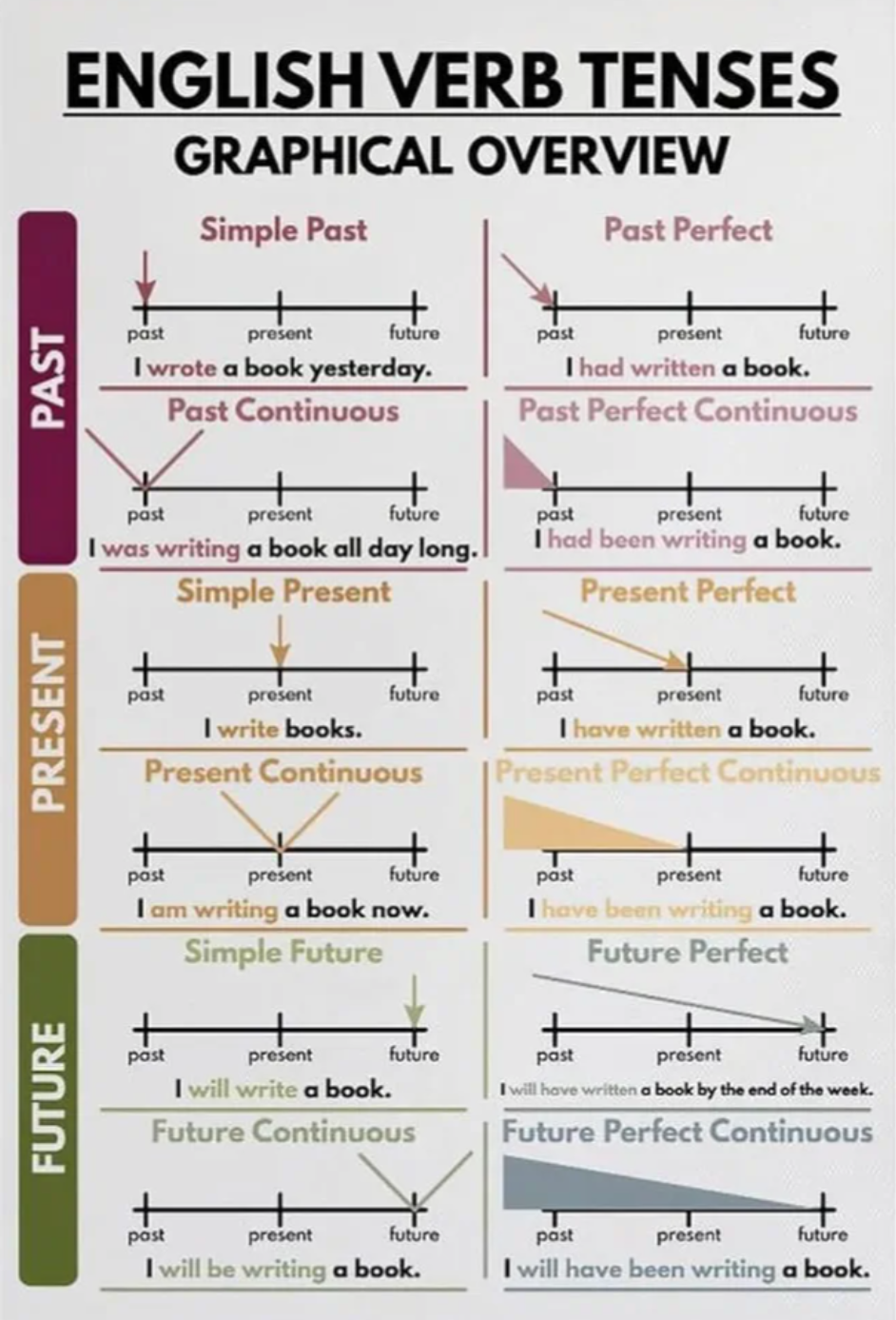
First, we have the Simple Past. It doesn’t tell us much other than something happened.
- I wrote a book.
- We drank tea.
Then we have the Past Continuous. It’s an ongoing event and we are peeping into the middle, before it finished.
- I was writing a book when Colin Firth knocked on my door.
- We were drinking tea all afternoon and I was hoping my bladder wouldn’t burst.
Past Perfect isn’t a rosy look back on your childhood. In grammar, ‘Perfect’ means a completed event, like when you’ve finished a jigsaw. The Past Perfect occurred before the time we’re talking about. It happened in the past, was finished in the past and stayed in the past. We’re often interested in what happened next.
- I had written a book, and I had sent a copy to Colin Firth’s agent, but all I heard back was stoney silence.
- We had drunk tea all afternoon. Sheila suggested we swap to gin.
Finally, the Present Perfect, like I have won an Olympic medal! (I haven’t.) While this sounds like a past tense, it is actually about the present. The focus is on my status now (Olympic medallist) because of what happened then (6.5m pole vault).
Look at that yellow arrow in the chart. It comes from the past and lands now. Something happened in the past, and it is complete, and my now has changed as a result.
- I have written a book and Colin Firth has agreed to play the hero. I can’t wait to start filming!
- We have drunk tea and now we need the loo.
Yes, and …?
Greek tenses don’t exactly match English ones (Why would they? That’d be far too simple), but we can make some links.
Simple Past is like the Greek Aorist. It simply happened.
- Jesus wept. (John 11: 35)
Past Continuous is like the Greek Imperfect. The event is ongoing.
- All the crowd was coming to him, and he was teaching (Mark 2:13)
Past Perfect is like the Greek Pluperfect. We’re talking about something that happened long ago, before the past.
- And Abraham went early in the morning to the place where he had stoodbefore the Lord. (Gen 19:27)
Present Perfect is like the Greek Perfect. Something happened that changes how it is now.
- And he said to the woman, “Your faith has saved you; go in peace.” (Luke 7:50)
Jesus didn’t say that the saving (btw, same word as healing) only happened in the past (Aorist), nor that it was unfinished (Imperfect), nor that it was something from long ago (Pluperfect). This healing is in the Perfect tense. It is a done deal, a completed event that will change her life in the present and the future.
So What?
“Lovely,” you say. “I now know far more about tenses than I ever feared.”
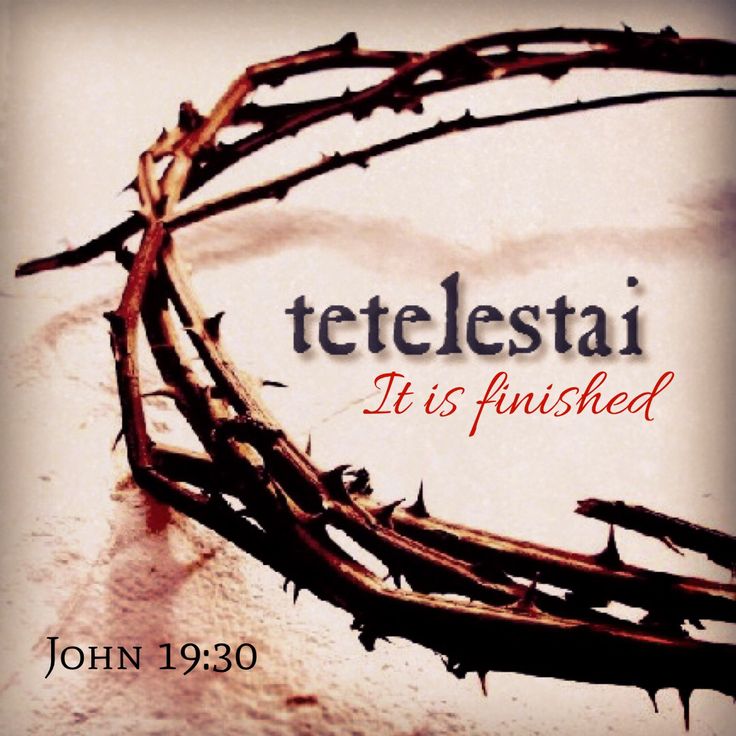 Here’s the mind-explosion. Jesus’ final words on the cross. It’s only one word, actually, but there is a whole universe in that one word. And it’s in the Perfect tense.
If you think it’s not important, run through Jesus’s final word in the other tenses. An event that simply happened with no consequences? An unfinished job, still ongoing? An event in the far past, irrelevant to today? Not exactly good news.
But Jesus used the Perfect tense to show that his work is finally complete, and its consequences are for now and the future.
The very word he spoke tells of that same concept. It means to finish, to complete, to perfect, to fulfil. It’s that final part of the jigsaw. It’s the foot over the finish line that wins gold. It’s the last push that gets the baby born. It’s the exam result that means you’re qualified. It’s the debt that now says, ‘paid in full’.
It’s done. It’s finished. And nothing will ever be the same.
τετέλεσται
Tetelestai!
It is complete!
 The Reflectionary