Another bumper selection for you! Below is a reflection on Genesis 32 and your lectionary-linked liturgy. But also we have a number of intergenerational packs (and remember that intergen does not mean ‘for the kiddies’) and the awesome sketch, How the Feeding of the 5000 Really Happened with video! Oh yes!
Resource Links
- Life Sticks – a tactile meditation of how experiences affect us
- Together Apart – 10-page PDF Jacob wrestles with God – Gen 32
- Ditto for Feeding 5000 – Matt 14
- Ditto but from John and with pizza / harvest focus
- Activities for Mt 14 from The Religion Teacher
- 4 Views on the significance of the miracle from Jesus without Baggage
A reminder that I produce these resources for free because I believe this stuff is important, so if you’d like to support the work, there are many ways you can do this:
 Spread the word – share posts via social media
- Buy my books – see the links on the sidebar
- Donate via paypal (see sidebar) or Buy Me a Coffee [click]
How the Feeding of the 5000 Really Happened
What’s in a Name?
Reflections on Genesis 32:22-31
There is so much about this passage that is familiar, but a whole load that makes us go, “What the flippin’ ‘eck is that about?”
Let’s start with the familiar. We’ve seen Jacob here before. Alone in the desert, at night, afraid for his life … and then something weird happens. First time it was a ladder, now it is a wrestling match. A brief recap of what’s happened since the last weird something:
Back in chapter 27, Jacob did his best-ever job of irritating his big brother Esau by stealing the eldest son’s blessing from their father. In return, Esau vowed to kill Jacob. Afraid for his life, Jacob legged it to his cousin Laban’s house, and while he was alone in the desert with nothing but the clothes he lay down in, he had a dream. He dreamed of the God that his father worshipped, and when he woke, Jacob had made a deal with him. The deal was that if the Lord would stay with him so that he could return to his father’s house in peace, then the Lord would be his God.
Twenty years later, Jacob has married both of Laban’s daughters, had eleven sons and grown very rich at Laban’s expense. Jacob seems to have forgotten about the deal with God, but as we will see, God is about to remind him. Laban has had enough of his son-in-law by now, so Jacob gathers all that he has and does a runner again.
We’re spotting a pattern in Jacob’s life – dodgy dealing until friends and family can’t stand him, then leg it and start all over again. Except this time he can’t start all over again. History is catching up with him. Particularly his brother Esau is catching up with him. Look back at the start of this chapter. As Jacob travels towards the land of his father, he sends a message to Esau in the neighbouring region. No doubt he was hoping for something along the lines of ‘Great to hear from you, bro. All is forgiven.’ Instead he gets stony silence and an approaching army of 400 men. Gulp.
Quickly, Jacob separates his family and possessions into two, so that if one group is slaughtered the other can escape, and puts a lot of distance between them and him. He knows he deserves nothing but trouble, fair’s fair after all. The night sees Jacob, once again alone, in the desert and frightened for his life. All his scheming has got him nowhere, not in the things that matter.
So he turns, finally, to God. He makes probably the one honest prayer in his life, asking God to deliver him from his furious brother. He admits that he does not deserve the least amount of God’s favour, but he asks for it anyway. And then something weird happens, and that where we come in.
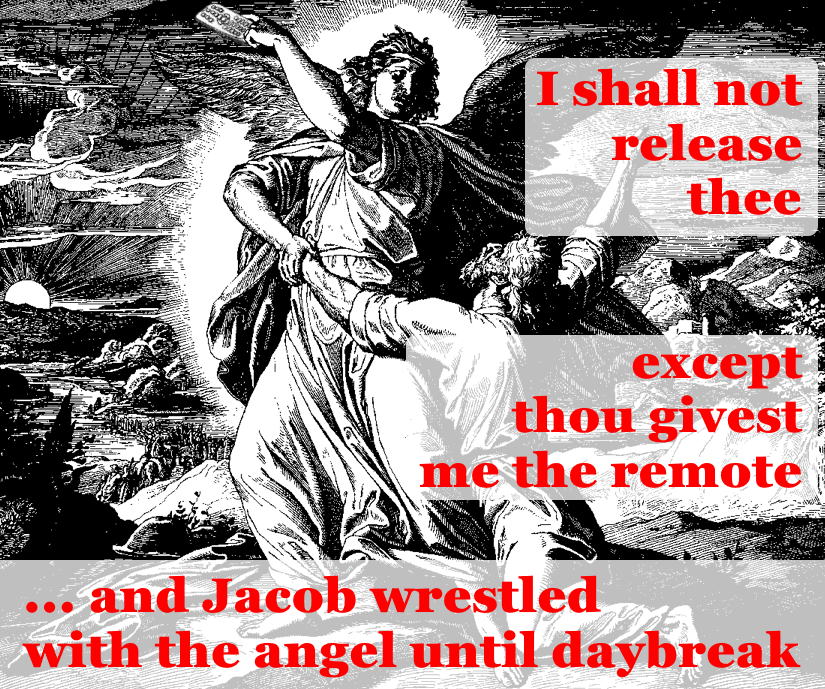
The Bible is infuriatingly vague about who this mysterious wrestler is. A man, and angel, the Lord God himself? Whoever it is, he declines to give his name and is eager to be away before daybreak. Is that so that Jacob does not see his face? After a long struggle, neither can subdue the other so the wrestler inflicts an instant injury on Jacob to end the fight. Presumably he could have done that at any time, and could have done a lot more if he had chosen. It was enough to show who had won but not enough to seriously injure. It’s like when I play with my cat and she grabs me with all her claws – not to hurt me, but to show who’s boss. Jacob understands that he is wrestling with God, and demands a blessing.
That’s an interesting request. Perhaps the struggle has reminded Jacob of all the struggles with his father, his brother, his father-in-law, and the ‘blessings’ he has stolen. The wrestler does not fulfil Jacob’s hunger for blessing right away, but instead directs Jacob’s attention to the root of the problem, his name. Jacob has spent his life living up to his name (it means ‘sneaky little rat-bag’) and it’s time to change.
So God renames the cheater. Instead of a name that hangs around his neck, dragging him down until he became what people called him, Jacob gains a name that takes the best view of his life. Israel – ‘He struggles with God’. It is a reminder of his Lord every time he hears his name, encouraging him to live up to his promise that ‘The Lord will be my God.’ And Jacob, now Israel, is instantly reformed.
No, he isn’t.
But he is changed. He wants to know the stranger’s name, like Moses after him, but here the name is kept hidden. The God that Jacob knows only dimly will stay dimly known for the moment. However, Jacob does get the blessing he has been struggling for all these years – a blessing given, not taken.
He leaves the scene a changed man. The limp is a permanent reminder of his encounter, and reassurance that it was not just a dream. Twenty years earlier, alone in the desert and frightened for his life, Jacob had asked that God stay with him. Israel found that he had.
[This article was first published in 2017]
Liturgy Resources for Proper 13
Isaiah 55:1-5, Psalm 145:8-9, 14-21, Matthew 14:13-21
Confession and Absolution
Lord God, we confess that we have not loved you with all our heart,
Lord, be is gracious and merciful,
nor with all our soul,
Lord, be is gracious and merciful,
nor with all our mind,
Lord, be is gracious and merciful,
nor with all our strength,
Lord, be is gracious and merciful,
And we have not loved our neighbour as ourselves.
Lord, be is gracious and merciful, and forgive us all our sins.
The Lord is gracious and merciful,
slow to anger and abounding in steadfast love.
The Lord upholds all who are falling,
and raises up all who are bowed down.
The Lord is near to all who call on him,
to all who call on him in truth.
This Lord, this Lord, forgives all who truly repent.
So know yourself forgiven, and rejoice.
Bless his holy name forever and ever!
OR
Lord God,
we confess that we have spent our money on that which is not bread,
forgive us, O Lord.
We have laboured for that which does not satisfy,
forgive us, O Lord.
We are hungry and thirsty, O Lord,
feed us with the bread of life.
Hear the words of your God:
All who thirst, come to the waters.
And you that have no money, come and eat.
Come to me and eat what is good, and delight in rich food.
Come to me that you may live.
Blessed be God for ever.
Blessing and Dismissal
May you bring what you have, great or little, to God,
may God bless your offering and use it to bless others,
and may you be blessed in the giving of that gift,
and the blessing of God Almighty, one in three and three in one,
be upon you and remain with you
now and always.
Amen.
Go, as those fed by God,
and tell of his wonders.
Amen.
 The Reflectionary