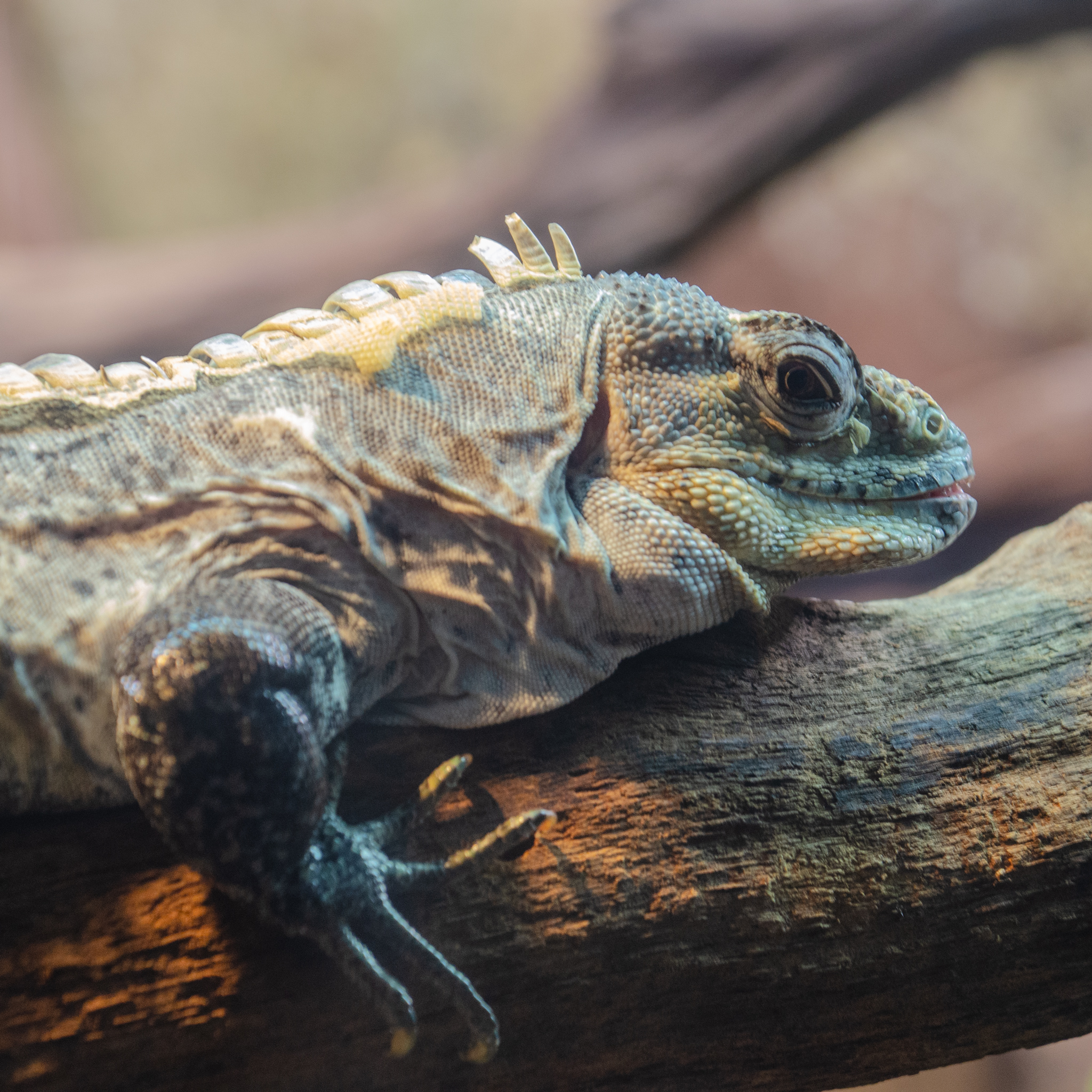
Basking in the warmth of an infra-red lamp, this odd creature totally ignored my presence. Didn’t even blink when the camera lens pointed in his(?) direction. Let’s assume male, and call him Gordon…
Such creatures are as different from us as they could be. Cold-blooded, insectivore, and armour-plated!
They occupy a completely different niche in the environment, and fit that place superbly. It is astonishing to see a living example of a creature that has almost nothing common with me. Living at Marwell Zoo, Gordon is kept in a specialised enclosure where the environment is controlled to his precise requirements, and food is provided on a regular basis.
Gordon doesn’t know any other existence. The rest of the world is an unknown abstraction except for naughty visitors tapping the glass- which must be quite scary. If a big looming lump knocked on our window at lunchtime we’d freak out too.
Science is a wonderful way of observing and understanding the world; it makes us ask questions about reality. Theology is another wonderful way of asking questions about important experiences and ideas. Do the two approaches oppose each other? I don’t think so: although both approaches compel us to examine our own foundations. From that examination should emerge deeper insights as well as great mysteries. Christian theology contends that God the Creator has chosen to reveal Himself, and thus help us to explore reality in context.
The beginning of John’s Gospel sets out a nugget of insight into these mysteries. To explore the “unknown” is a great adventure. To think through this short statement of theology is a fine launching pad.
In the beginning the Word already existed.
    The Word was with God,
    and the Word was God.
He existed in the beginning with God.
God created everything through him,
    and nothing was created except through him.
The Word gave life to everything that was created,
    and his life brought light to everyone.
The light shines in the darkness,
    and the darkness can never extinguish it.

- John 1 v1-5
 The Reflectionary