1 Timothy 6:6-19 and Luke 16:19-31
Let’s start with some maths. (Oh, go on. Please, please, please?)
Cleaning my house involves Time and Work
Cleaning = Time x Work
We work to get money, so
Work = Money
And we all know the phrase “Time is Money”, so
Time = Money
Substitute those in and we find that
Cleaning = Money x Money
or
Cleaning = Money2
But Money, we’re told in 1 Tim 6:10, is the Root of Evil
Money = √Evil
Squaring both sides, we get
Money2 = Evil
Therefore
Cleaning = Evil
 And since 1 Thess 5:22 tells us to abstain from every form of evil, I’m not going to clean my house anymore. For the good of my soul, you understand. Not laziness. That’s my story and I’m sticking to it. 😁
Hopefully you are howling, “misquote!!!” at me. According to 1 Tim 6:10 it’s the love of money that is a root of all kinds of evil, rather than the money itself. We saw last week, with the Parable of the Dishonest Steward, how ‘filthy lucre’ can be used for God’s Kingdom. The problems come when we hold too tightly on to what has been entrusted to us.
While I have a research degree in maths, economics has always proved a mystery to me. It seems to break the First Law of Thermodynamics – the one that says you can’t get owt for nowt.
Imagine five people: A cobbler who has a broken tap, a plumber who is hungry, a cook who has no ingredients, a farmer who has toothache and a dentist whose shoes leak.
Each has £100. They could all simply keep their £100 and be miserable. Or the cobbler could pay the plumber £100 to fix their tap, the plumber could pay the cook £100 for food, the cook … You see how it goes. They would each end up with the £100 they started with, but the plumber would be fed, and the dentist would have dry feet.
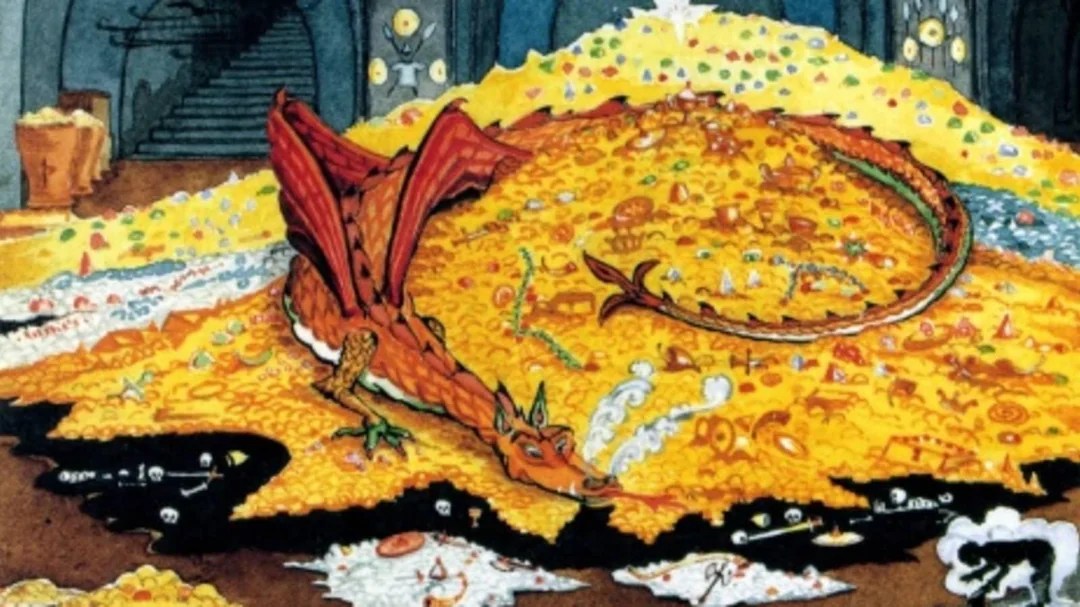 Using money can make good things happen. Sitting on a pile of cash, like a dragon on a hoard of gold, is good for neither happiness nor haemorrhoids!
A common answer to the question “How much money is enough?” is “Just a little more”. Even when said in jest, there is truth behind it. As soon as we have that ‘little more’, we want a little morer.
“I’ll be happy once I get that promotion.”
“I’ll settle as soon as I max out my ISA.”
“I’ll be comfortable when my pension hits 100 grand.”
 I’m sure the rich man in Jesus’ parable said plenty of things like these as he sat in his nice house and had his servants move the smelly beggars aside so that they didn’t spoil his view. In August this year, a certain orange president was annoyed at seeing homeless people while he was being chauffeured to his golf club. “The Homeless have to move out, IMMEDIATELY,” he wrote, and within days, the bulldozers moved in. Has ever a parable rung more true?
Amos has a lot to say about how wealth can blind us to the needs of others, and he never pulls his punches:
Woe to those who are at ease in Zion and for those who feel secure on Mount Samaria. Woe to those who lie on beds of ivory and lounge on their couches and eat lambs from the flock and calves from the stall, who sing idle songs to the sound of the harp and like David improvise on instruments of music, who drink wine from bowls and anoint themselves with the finest oils but are not grieved over the ruin of Joseph! (NRSV)
 A couple of years ago, we went to see a travelling circus in the next-door village. My favourite act was a guy who rode a penny farthing … on a tightrope!
Handing money is a bit like that guy. To far this side and you fall. Too far the other side and you fall too. Too little money is a huge stress, and a misery for millions. But too much can narrow our vision so much that all we see is ourselves.
I used to be married to a guy who claimed he was too poor to pay child support, despite a take-home salary over £10,000 a month. Money itself is not bad, but when we fall in love with the lifestyle it buys, we can lose sight of what is important. For some, their winter sports holiday is a necessity. For others, it’s winter shoes for the kids.
Two things I ask of you, Lord; do not refuse me before I die: Keep falsehood and lies far from me; give me neither poverty nor riches, but give me only my daily bread. Otherwise, I may have too much and disown you and say, ‘Who is the Lord?’ Or I may become poor and steal, and so dishonour the name of my God. Prov 30:7-9 (NIV)
Of course, it’s sensible to have a ‘rainy day’ fund if we can afford it. General wisdom says aim for 3-months’ worth of bills. That’s quite a hefty amount. Way beyond the means of many. But it’s 3-months’ worth of bills – rent, electricity, food – not holidays, new clothes and dining out. If we end up accumulating wealth for the lifestyle to which we’d like to become accustomed, we get back to our circle of five people, all hugging their £100 and greedily looking to see how much they can get from someone else. Not a pretty picture.
Instead, let’s follow Paul’s advice to Timothy when it comes to gaining treasure.
There is great gain in godliness combined with contentment, for we brought nothing into the world, so that we can take nothing out of it. Do good, be rich in good works, generous, and ready to share, thus storing up for ourselves the treasure of a good foundation for the future, so that we may take hold of the life that really is life.
(NRSV, adapted, my emphasis)
Some useful links:
Martin Lewis (bless his cotton-blend socks) has helpful guides on budgeting and saving.
https://www.moneysavingexpert.com/banking/budget-planning/
https://www.moneysavingexpert.com/savings/which-saving-account/
The BBC has a fascinating article on how being money-primed makes us meaner.
https://www.bbc.co.uk/news/magazine-31761576
 The Reflectionary