 I have a shape in my hand. If I hold it to the light, it gives a square shadow. What is my shape?
Most people will say a cube, and that’s a perfectly reasonable answer. It fits what we see exactly and is the most likely shape.
Thinking about the square shadow that we can see tells us a lot about the unknown shape that we can’t see. But it won’t tell us everything. I could have a chip shape, for instance. That could also give a square shadow. The square shadow is true, but it is not the underlying truth.
I have a shape in my hand. If I hold it to the light, it gives a round shadow. What is my shape?
A sphere or a ball? Great answer. That’s how we know that the sun and planets are spheres – the only shape that’s always a circle whichever side you look at.
Thinking about the circular shadow that we can see tells us a lot about the unknown shape that we can’t see. But it won’t tell us everything. I might be holding a cylinder, or even a cone. The circle shadow is true, but it is not the underlying truth.
 I have a shape in my hand. If I hold it to the light, the shadow is a triangle. What is my shape?
This one’s a bit harder. Is it a Toblerone shape (triangular prism)? It a fancy-schmancy tetrahedron like those pyramid teabags? Both of those are good answers.
Thinking about the triangular shadow that we can see tells us a lot about the unknown shape that we can’t see, even if it perplexes us somewhat. But it won’t tell us everything. The triangle shadow is true, but it is not the underlying truth.
And here’s the weirdest thing of all. I don’t have three shapes. I have one. Each aspect of my shape is true – it looks like a square from one direction, a circle from another and a triangle from the third, and these seem incompatible – yet you need all three aspects to comprehend the truth.
It is a real shape. Imagine sawing a chunk off a broom handle, as tall as it is wide. Then shave off the sides at the top so that it makes an edge, like a chisel tip. Some marker pens have tips this shape, round at the base and tapering to a line at the top.
Having trouble getting your head around it? Don’t worry. Today is Trinity Sunday, the day when ministers the world over foist their sermons onto unsuspecting curates in an attempt to avoid falling into one heresy or another be that Docetism, Sabellianism or the tongue-twisting Monophysitism.
I’m not suggesting that my funny little felt-tipped-pen shape is a model of the Trinity – that’s way above my pay grade – but I am suggesting that just ‘cos we can’t get our heads around something does not stop that something existing.
We might grasp aspects of true and struggle to combine them into truth, but that’s OK. Most of the heresies I’ve listed below were people trying to understand truth, but veering too far one way or the other. Some were even attempts to counter false teaching, but resisted it so hard they became the opposite heresy!
So be comfortable with not being able to put the Trinity into words. Any words you pick would not do God justice anyway. Today we see, as Paul said, ‘in a glass, darkly’. We’ll get to understand fully in heaven, and then we’ll have eternity to figure it out. The shadows we see now are helpful in understanding the real shape, even if we can’t really comprehend it. Just don’t stare too hard at the square that you ignore the triangle or the circle. ‘Cos God’s not a cube.
Here are some heresies you may like to choose from avoid when preparing your sermon for Trinity Sunday.
Adoptionism
Jesus was born as an ordinary human and later – either at his baptism or his resurrection – was adopted as God’s son.
Arianism
Arius denied the eternal divine nature of Christ, teaching that he was the first and greatest of God’s creatures, god-like, but not eternally God. This idea was addressed in the Nicene Creed.
Docetism
Conversely, this heresy says that Jesus Christ was purely divine and only appeared to have a human body (from δοκέω, to seem or appear).
Ebionitism
A heresy from early Jewish Christians, this teaches that Jesus was the human son of Mary and Joseph who perfectly followed the letter and spirit of the Law and so was adopted as God’s messiah. We must follow both the Law of Moses and the moral teachings of Jesus to be righteous.
Gnosticism
Again from the Greek γνῶσις (knowledge, enlightenment), this long-lasting heresy maintains that you need special knowledge to be saved. You’ll find it today in Scientology and Mormonism, for example.
Gnostics often separated material things from spiritual, with matter, earth and bodies being bad, spirit, heaven and souls being good. Thus Gnostics deny that Jesus is God come in flesh because flesh is ikky.
Macedonianism
This denies the divinity and/or personhood of the Holy Spirit. The Holy Spirit is a created being or an impersonal force.
 Modalism
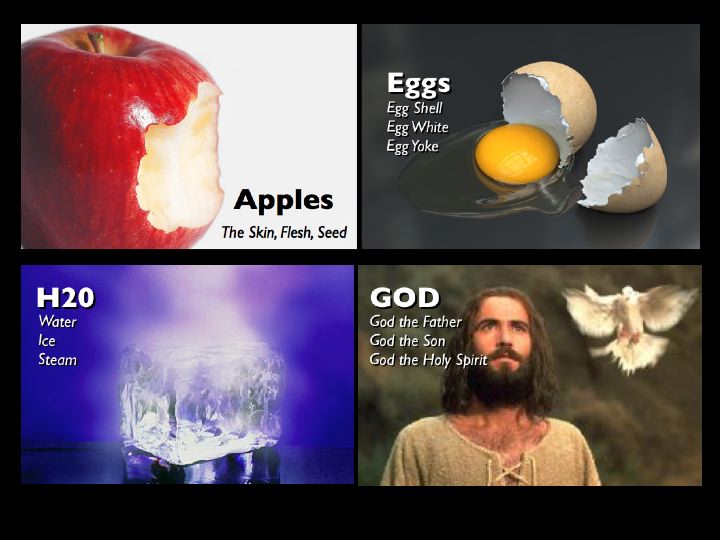
Also called Sabellianism, this is your ‘three-leafed clover’ or ‘water/steam/ice’ analogy. The three persons of the Trinity operate as different ‘modes’ of God: the Father in creation, the Son in redemption, and the Spirit in sanctification. You’ll also hear that the Old Testament was about the Father, the New Testament about the Son, and we are now in the age of the Spirit.
In case you’re tempted, God does not swap from being Father to Son, as water swaps from solid to liquid as it melts. Nor is God composed of separate parts, as an egg or an apple. Taken to extremes modalism morphs into Tritheism: three separate gods who share the ‘same substance’.
Monophysitism
This is the idea that Jesus has/had a single nature, a hybrid divine-human nature, denying the distinctness of his divine and human natures.
Nestorianism
Conversely, Nestorius separated the divine and human natures of Christ to the extent that he made Jesus two distinct persons rather than one person with two natures.
 Subordinationism
This teaches a hierarchical within the Trinity, usually the Father at the top, the Son below and the Spirit beneath.
Partialism (Out of alphabetical order, but I wanted to end on bang.)
Each person of the Trinity is one part of God and they only form the whole God when combined. Kind of like Power Rangers, where each Ranger – red, blue, black, yellow – has their own robot Zord which, when faced with the Monster of the Week, combine to form the all-powerful Megazord.
See, it was worth reading right to the end!
 The Reflectionary