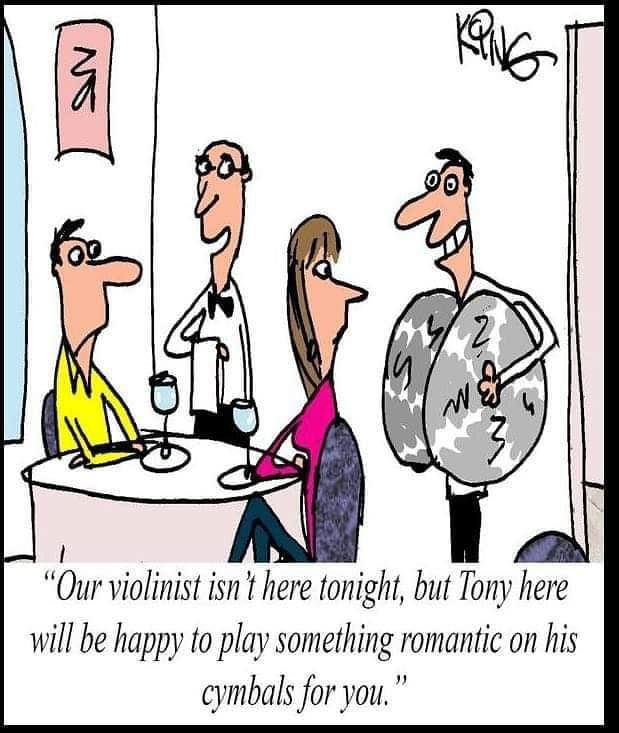
 In my earnest and callow youth, I went on a student Christian conference which was tri-lingual: French, German and English. One of the praise songs was a rendering of Psalm 150 which contained the wonderous phrase ‘wohlklingenden Zimbeln’. Sadly, I didn’t speak German, so the band was on the next song by the time I had parsed that gargantuan word!
But while the loud instruments of Ps 150 are good for joyful praise, I don’t think I’d want to live with such raucous music all the time. (Definition of a gentleman: one who knows how to play the bagpipes, but doesn’t.) In our reading from Corinthians, Paul uses the image of ‘clashing cymbals’ as a picture of a person who talks a lot and says nothing. All mouth and no trousers, we’d say these days.
In cities such as Corinth there were fashionable philosophers who plied their trade in talk. (Philosophers were pop stars then. That’s what happens when you don’t have Netflix.) They were professional speakers and liked the sound of their own voices, but they didn’t have the believe it. Whether it was true or not was irrelevant. (Know anyone like that in the news?)
Paul spent the first few chapters of 1 Corinthians emphasising that he wasn’t one of those pop-philosophers. His words were full of God’s truth and power, not mere nice-sounding human ideas.
I did not come with eloquence or human wisdom as I proclaimed to you the testimony about God. For I resolved to know nothing while I was with you except Jesus Christ and him crucified. (1 Cor 2:1-2)
Now, to be honest, Paul is being modest here. He’s a trained rabbi; he studied under Gamaliel, one of the top bods of his age, so Paul could string together a decent sentence, but that’s not the point. It’s not his words that are important, but the demonstration of truth that backs them up.
My message and my preaching were not with wise and persuasive words, but with a demonstration of the Spirit’s power, so that your faith might not rest on human wisdom, but on God’s power. (1 Cor 2:4-5)
Paul turns this same principal of the Corinthians themselves. “If I (meaning ‘you’) speak in the tongues of humans and of angels but do not have love, I am (meaning you are) a noisy gong or a clanging cymbal.” The words, the giftedness, the show, they mean nothing if there’s no love of God, love of neighbour, behind them. Here’s an example that I hope I never have to face.
It’s one thing to say, “Oh yes, I a very forgiving person.” It’s something quite different to do what Corrie ten Boom had to do when faced with one of her former captors.
Two years after the liberation of Ravensbrück concentration-camp, Corrie had been speaking of God’s forgiveness, and of our need to forgive those who have harmed us. At the end of the service a man approached her and held out his hand – a former guard. She recognised him immediately.
“It came back with a rush,” recalled Corrie. “The huge room with its harsh overhead lights; the pathetic pile of dresses and shoes in the centre of the floor; the shame of walking naked past this man.” She fumbled in her pocket rather than take the hand than had cause to much misery.
“You mentioned Ravensbrück in your talk,” he said. “I was a guard there, but since that time, I have become a Christian. I know that God has forgiven me for the cruel things I did there, but I would like to hear it from your lips as well.” He held out his hand again. “Fraulein, will you forgive me?”
Corrie wrestled with the most difficult thing she had ever had to do. “For I had to do it,” she later wrote. “I knew that. The message that God forgives has a prior condition: that we forgive those who have injured us.”
Remembering that forgiveness is not an emotion but an act of the will, Corrie prayed, “Jesus, help me! I can lift my hand. I can do that much. You supply the feeling.”
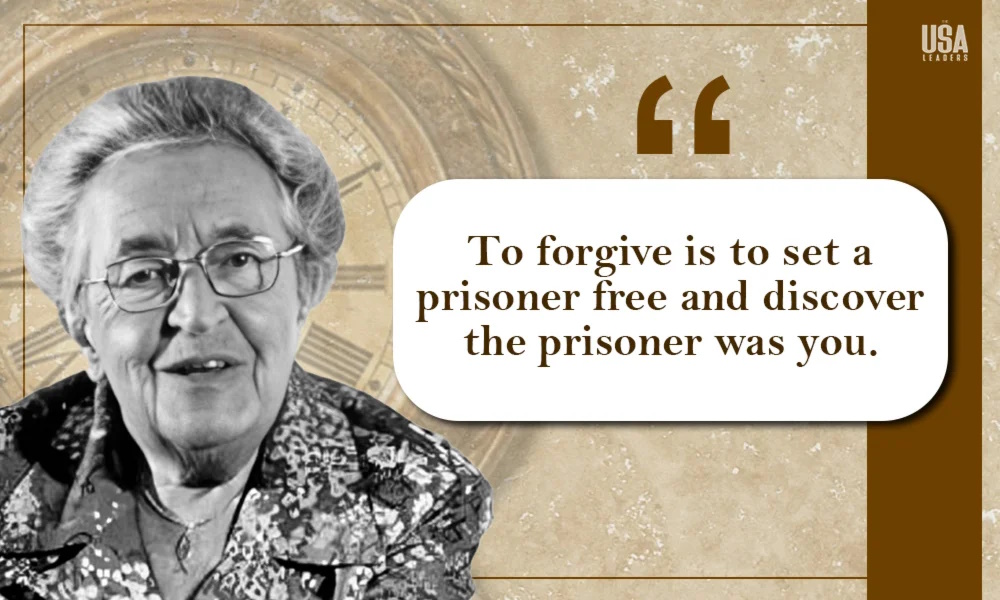 She took the waiting hand, and in that moment, “a current,” she wrote, “started in my shoulder, raced down my arm, sprang into our joined hands. And then this healing warmth seemed to flood my whole being, bringing tears to my eyes. ‘I forgive you, brother!’ I cried, ‘with all my heart.’
“For a long moment we grasped each other’s hands, the former guard and the former prisoner. I had never known God’s love so intensely as I did then. But even so, I realized it was not my love. I had tried, and did not have the power. It was the power of the Holy Spirit.”
If I speak in the tongues of men or of angels, but do not have love, I am only a resounding gong or a clanging cymbal.
Corrie ten Boom The Hiding Place
Liturgy Resources for the Fourth Sunday after Epiphany
Confession and Absolution
Love is patient; love is kind.
But, Lord, I am not. Forgive me, I pray.
Forgive me and help me.
Love is not envious or boastful or arrogant or rude.
But I am. Forgive me, I pray.
Forgive me and help me.
Love does not insist on its own way; it is not irritable; it keeps no record of wrongs.
But I have a short temper and long memory. Forgive me, I pray.
Forgive me and help me.
Love does not rejoice in wrongdoing but rejoices in the truth.
It bears all things, believes all things, hopes all things, endures all things.
Lord, I wish I were more like this, more like you. Forgive me, I pray.
Forgive me and help me.
May God, who is perfect love,
forgive and restore you
and grow you into his love.
Amen.
Blessing and Dismissal
May you see God, not only a reflection,
as in a mirror, but face to face.
May you know God, not only in part,
but fully, even as we are fully known.
And the blessing …
And now faith, hope, and love remain, these three.
Go in the greatest of these; go in love.
Amen.
 The Reflectionary