There’s none so blind as those that will not see. So goes the saying. It sounds like it’s from the Bible and, while not a direct quote, it has its roots in the Scriptures, especially Jer 5:21 “Hear this, you foolish and senseless people, who have eyes but do not see, who have ears but do not hear” and the sayings of Jesus, such as “Do you have eyes but fail to see, and ears but fail to hear?” (Mark 8:18)
 The most deluded people are those who choose to ignore what they already know. And we are all very good at it, unfortunately. The famous passage from 2 Samuel 11 & 12 is a worked example of self-delusion: King David rants at the injustice of a man who has everything taking from one who has little, all the while failing to recognise himself. He even invokes God’s name in condemning the sinner, the very height of spiritual blindness! (In case you don’t know, David had raped Bathsheba, wife of Uriah, got her pregnant, then had Uriah killed to cover up the ‘awkwardness’.)
But (cartoon screech of brakes), before we jump on our high horses and tut self-righteously at David’s hypocrisy, remember that’s exactly what he was doing: being cross at someone else’s faults while blind to his own. I wouldn’t be doing that at all, would I? When we get to the climax of this story where Nathan proclaims, “You are that man!” be aware that we are David, not Nathan.
Daniel Kahneman, who died earlier this year, was a Nobel Prize-winning psychologist best-known for his work on the psychology of decision-making. In his book Thinking, Fast and Slow, he says, “We’re blind to our blindness. We have very little idea of how little we know.”
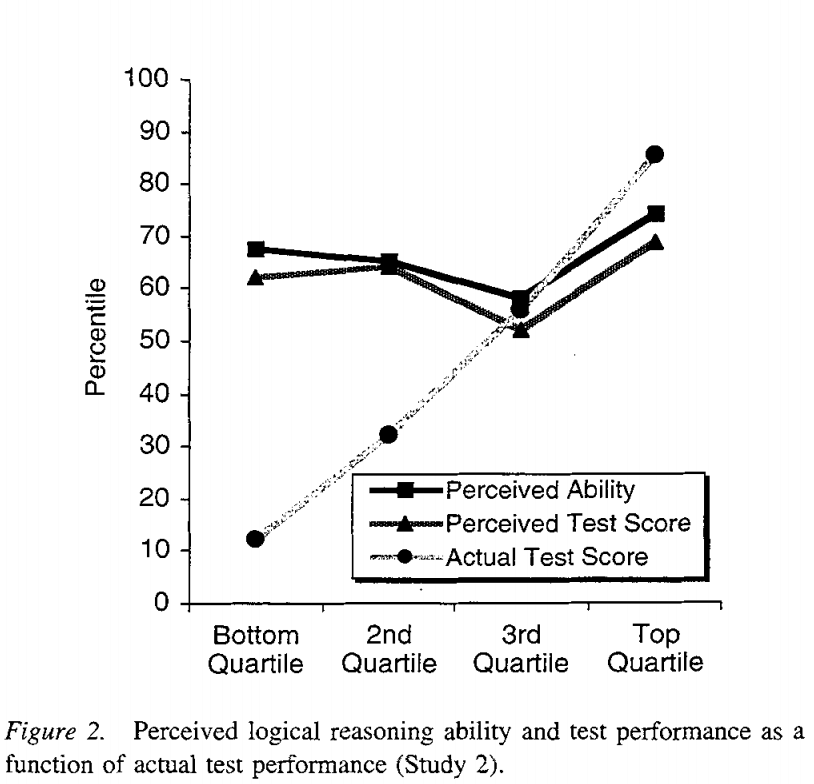 It loops back to the Dunning-Kruger curve. Dunning and Kruger described the tendency of people with low ability in a specific area to give overly positive assessments of this ability. This is understandable, since most people think they are better than average, so those who are least competent are most likely to over-estimate their competence and by the largest amount.
Conversely, those most skilled are more likely to underestimate their skill due to both the ‘regression towards the mean’ effect and their heightened awareness of what they do not know. Here’s an actual graph from Dunning and Kruger’s 1999 paper. (Not quite what you see on the ‘web, but the gap between real and perceived ability is clear.)
To quote D&K, “In sum, we present this article as an exploration into why people tend to hold overly optimistic and miscalibrated views about themselves. We propose that those with limited knowledge in a domain suffer a dual burden: Not only do they reach mistaken conclusions and make regrettable errors, but their incompetence robs them of the ability to realize it.” D&K then note that they may themselves be subject to this cognitive bias and have massively misinterpreted their results, but were unable to see it. Oh, that God would grant us all such clarity of vision!
Or, in the words of Rabbie Burns,
O wad some Power the giftie gie us
To see oursels as ithers see us!
Amen to that!
References (I don’t get to use this heading often!)
- Kruger, Justin; Dunning, David (1999). “Unskilled and Unaware of It: How Difficulties in Recognizing One’s Own Incompetence Lead to Inflated Self-Assessments”. Journal of Personality and Social Psychology. 77 (6): 1121–1134. CiteSeerX 10.1.1.64.2655. doi:10.1037/0022-3514.77.6.1121. PMID 10626367. S2CID 2109278.
Psalm 51 / 2 Sam 11,12 Resources
Reflections – with Eton Mess activity
How Come I Didn’t See That Before? – with activity
Scandal! – with science activity
 The Reflectionary